Beyond the Ink: Karo Maha's Call for Industry Leadership, Accountability and Cultural Change
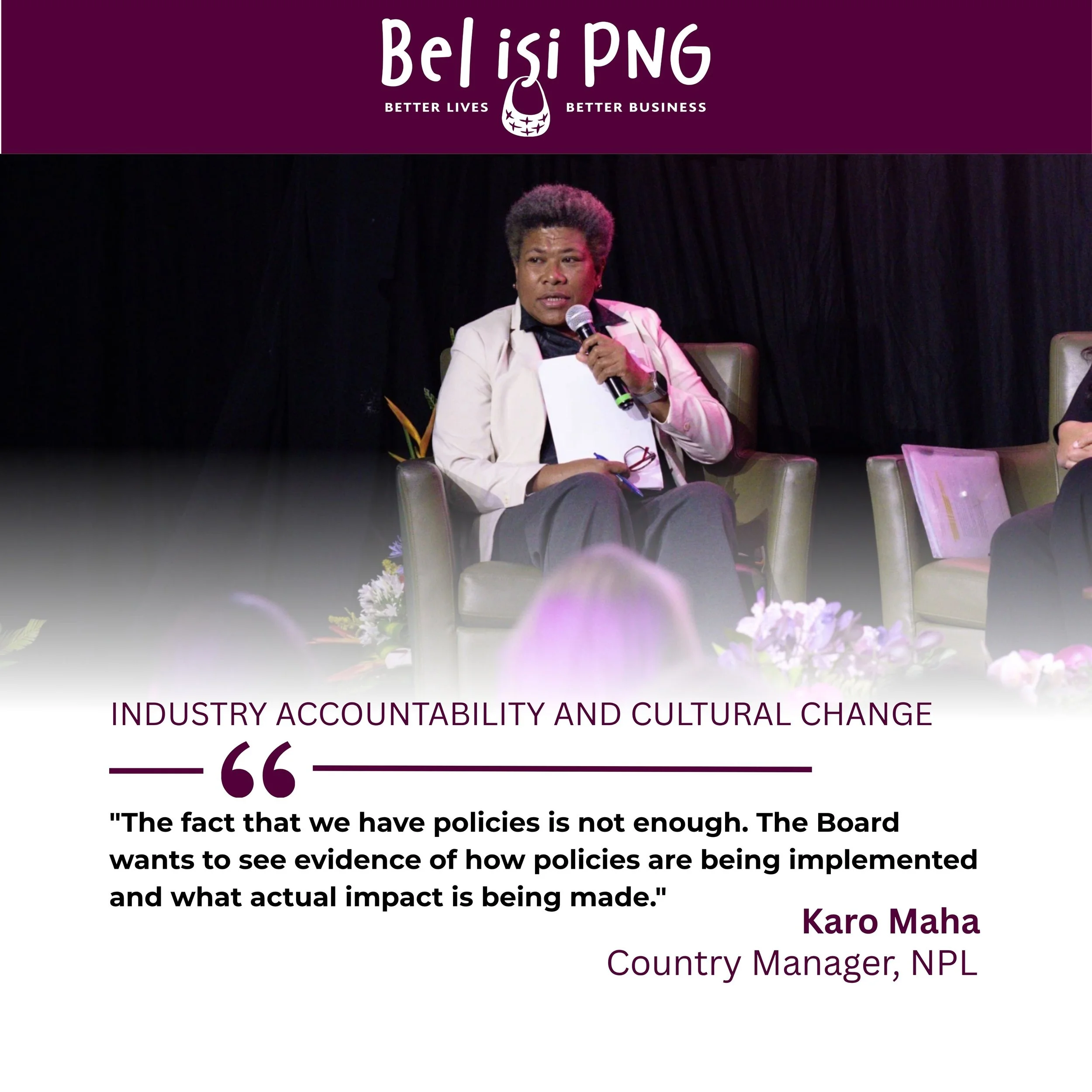
For Karo Maha, leadership is not defined by policy documents, committee meetings or corporate statements. Leadership is measured by action, accountability and the courage to influence change where it matters most.
Speaking at the Bel isi PNG Leadership Forum under the theme Beyond the Ink: Moving GBV and FSV Policies from Commitment to Action, Karo Maha shared practical insights from the resources sector on how organisations can move beyond policy commitments to create safer workplaces and stronger communities. As Country Manager of New Porgera Limited and Chair of the Women in Resources & Energy (WiRE) Committee under PNG CORE, she highlighted the critical role industry can play in influencing positive behaviour, supporting women’s participation and strengthening accountability
Progress Begins with Accountability
The Women in Resources & Energy Committee was established to provide leadership within the resources and energy sector and to ensure companies are not only developing policies but implementing them in meaningful ways. According to Karo Maha, the committee provides a platform for members to share expertise, build partnerships and strengthen accountability across the industry.
She noted that creating safer and more inclusive workplaces requires sustained commitment and practical action rather than policy compliance alone. Industry leadership, she said, must be reflected in measurable actions, stronger partnerships and a willingness to address difficult social issues affecting workers and communities.
The committee's commitment to action was further reflected in PNG CORE's launch of its Gender Equality and Social Inclusion (GESI) Policy Statement in July, providing a framework to support industry-wide efforts toward safer, more inclusive and equitable workplaces.
Her message reflected a reality familiar to many employers operating in the resources sector. Across Papua New Guinea, mining, petroleum and energy operations are often located in remote environments where social challenges outside the workplace directly affect employees, families and communities.
At Porgera, where she heads the country operations, the environment presents unique challenges. Tribal conflict, sorcery accusation-related violence, law and order concerns and deeply entrenched social norms can significantly affect the safety and wellbeing of women, girls and young people. Yet, she believes these realities also present opportunities for meaningful change.
Rather than attempting to solve these challenges alone, she advocated for practical partnerships between companies and organisations with expertise in community development, advocacy, prevention and behaviour change. Such partnerships enable businesses to contribute more effectively to efforts to prevent violence and promote safer communities.
Through initiatives such as workforce education and values-based training, resource companies can influence attitudes and behaviours not only within their workplaces but also in the communities where employees live. Karo Maha explained that because many workers come directly from local communities, positive values learned at work can extend into homes and communities and help influence future generations.
Equal Representation
Throughout her career, Karo Maha has been a strong advocate for increasing women’s participation in leadership and decision-making spaces. During the forum discussion, she highlighted the importance of ensuring women are represented on landowner company boards, community bodies and local governance structures.
She emphasised that women must have meaningful opportunities to contribute to decisions that affect their communities and futures. Greater representation strengthens governance, improves decision-making and ensures diverse perspectives are included in development planning.
Translate Vision to Action
Recognising that women’s voices are often underrepresented in traditional leadership structures, Karo Maha highlighted the importance of creating dedicated mechanisms that support women’s participation and leadership. Dedicated structures such as women’s community development committees can help ensure women’s perspectives are considered in community decision-making processes.
She also stressed the importance of ensuring women and young people participate in discussions that shape long-term development priorities and community outcomes.
Meaningful Participation Is Not About Symbolic Representation
Meaningful participation goes beyond simply providing women with a seat at the table. It requires creating genuine opportunities for women to influence decisions, identify emerging challenges and contribute solutions based on their experiences and understanding of community needs.
In communities experiencing development pressures, social change and resettlement impacts, these perspectives can be critical in ensuring programs and services effectively respond to the realities faced by women and families.
Culture Should Never Be Used as an Excuse for Violence
One of the strongest messages delivered by Karo Maha centred on the role of culture in addressing violence. Rather than accepting violence as inevitable, she encouraged organisations and communities to reclaim the positive values that have historically underpinned Papua New Guinean societies.
She spoke about honesty, respect, care for others and collective responsibility as enduring values that can help create safer environments for women and girls. These values, she argued, should form part of the solution to violence rather than allowing harmful behaviours to be justified in the name of culture.
Her reflections reinforced an important message: culture should never be used as an excuse for violence. Positive cultural values can be powerful tools for promoting respect, strengthening communities and supporting lasting change.
By creating pathways for women to lead, empowering communities to reject harmful behaviours and holding institutions accountable for action, the resources sector can play a transformative role in addressing gender-based violence and family and sexual violence.
As Papua New Guinea continues its journey beyond policy commitments, leaders such as Karo Maha are demonstrating that lasting change requires more than compliance. It requires leadership that is visible, accountable and willing to influence both workplaces and communities.
For the resources and energy sector, moving beyond the ink means ensuring that every initiative, partnership and leadership decision contributes to building safer workplaces, stronger communities and greater opportunities for women.