Beyond the Ink: Leslie Mamu's Push to Make Legal Protection a Reality for Survivors
When discussions on gender-based violence (GBV) and family and sexual violence (FSV) turn to laws and policies, it is easy to assume that the existence of legal frameworks alone guarantees protection. Yet for Leslie Benjamin Mamu, Public Solicitor of Papua New Guinea, the real test of any policy lies not in what is written, but in whether survivors can access justice when they need it most.
Speaking at the Bel isi PNG 7th Annual Leadership Forum under the theme “Beyond the Ink: Moving GBV and FSV Policies from Commitment to Action," Mr. Mamu offered a perspective grounded in the realities faced every day by women and children seeking protection from violence. As head of the Public Solicitor's Office, he occupies a critical position within Papua New Guinea's justice system, ensuring that legal representation and support are available to those who would otherwise be unable to afford it.
Access to Justice
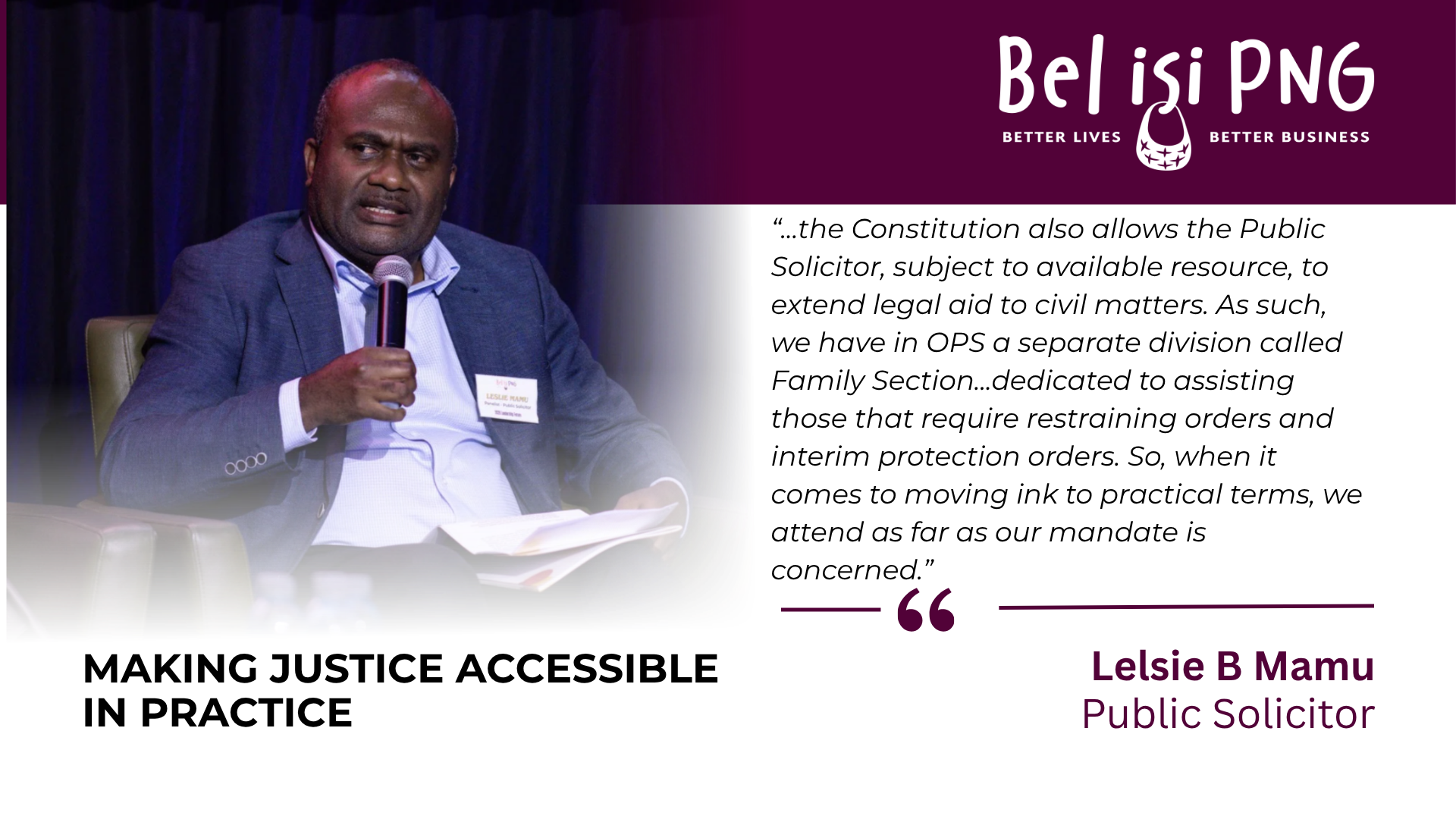
While the Public Solicitor's constitutional mandate is widely associated with criminal defence, Mr. Mamu highlighted an often-overlooked aspect of the office's work: a dedicated family section that assists survivors of GBV and FSV through civil law interventions, including Interim Protection Orders (IPOs) and restraining orders. These legal tools can provide immediate safety and protection for survivors facing ongoing threats or violence.
However, Mr. Mamu was candid about the challenges. Accessing justice is not always straightforward, particularly for people living outside major urban centers. Delays in securing protection orders, limited legal services in rural areas, and inconsistent enforcement can all undermine survivor safety. He stressed that action must focus on closing these gaps and ensuring that legal protections are not merely theoretical rights but practical safeguards available to every Papua New Guinean.
Strengthening Referral Pathways
A significant part of that effort has involved strengthening referral pathways and expanding legal knowledge beyond the courtroom. Recognizing that many survivors first seek help through village courts, community leaders, safe houses, police officers, or frontline service providers, the Public Solicitor's Office has invested in training referral partners to understand the law and navigate legal processes effectively. These trainings include guidance on completing protection-order applications and using simplified legal forms such as Form 124 in the Human Rights Track of the National Court, designed to make the justice system more accessible.
Proactive Approach to Escalating Serious Cases
Importantly, Mr. Mamu has also sought to address weaknesses in the enforcement of protection orders. Drawing on the experience of his office, he noted that perpetrators sometimes disregard district court orders. In response, the Public Solicitor issued an internal practice direction to his lawyers in 2024 which essentially adopts a more proactive approach by escalating serious cases to the National Court through the Human Rights Track to secure stronger, permanent restraining orders where necessary. This approach reflects a commitment not only to obtaining legal orders but also to ensuring they carry practical weight and real-world consequences.
His contribution to the forum reinforced a broader message: combating GBV and FSV requires institutions to move beyond compliance and into implementation. Legal frameworks are essential, but they must be supported by trained personnel, effective enforcement, informed communities, and coordinated services that survivors can access regardless of where they live.
Mr. Mamu's leadership demonstrates that justice is not delivered solely through courtrooms. It is built through partnerships, capacity building, and deliberate efforts to remove barriers that prevent survivors from seeking help. By taking legal services beyond urban centers and equipping referral partners with practical tools and knowledge, he is helping transform legal protections from words on a page into pathways toward safety and dignity.
As Papua New Guinea continues its journey to address GBV and FSV, Mr. Mamu's work serves as a reminder that policies matter only when people can feel their impact. For survivors seeking protection, the true measure of progress is not the existence of laws, but the confidence that those laws will work when they need them most.