Beyond the Ink: How BSP is Turning Corporate Commitment into Measurable Action
When organizations speak about gender-based violence (GBV) and family and sexual violence (FSV), the conversation often begins with policies. Yet for BSP Financial Group Limited, policy is only the starting point.
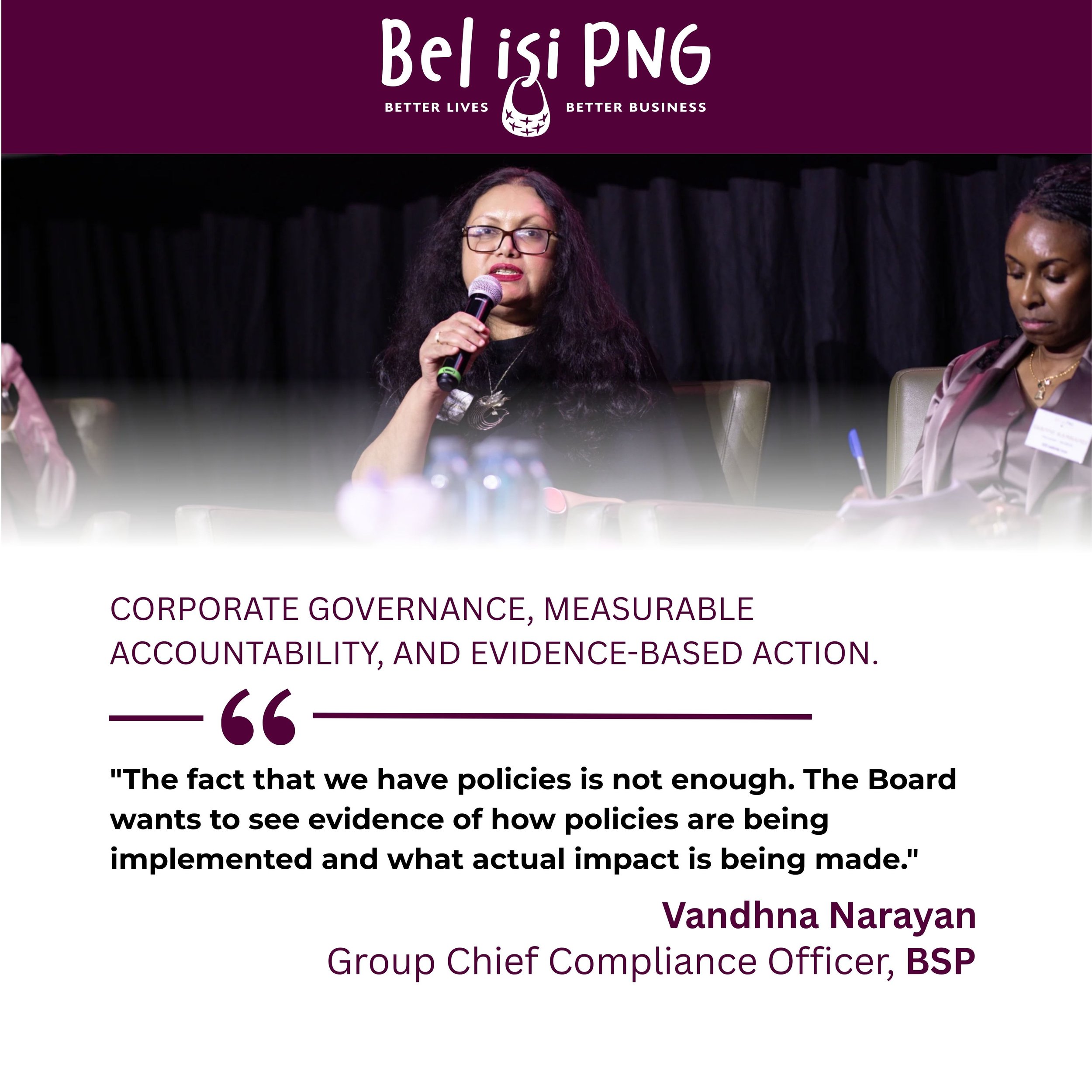
Speaking at the Bel isi PNG Leadership Forum under the theme “Beyond the Ink: Moving GBV and FSV Policies from Commitment to Action," Vandhna Narayan, BSP's Group Chief Compliance Officer and Chair of GBV Committee, shared how the organization has worked over the past decade to transform commitment into measurable action by embedding GBV prevention and response into governance structures, workplace culture and employee support systems.
At BSP, GBV is no longer viewed solely as a social issue. It is recognized as a business, governance and workforce issue that requires leadership, accountability and sustained investment. As part of this commitment, BSP has incorporated GBV as a formal pillar of its Environmental, Social and Governance (ESG) framework, ensuring oversight through governance structures that report through to the Board Risk Committee. This means GBV-related commitments are monitored at the highest levels of the organization and are subject to the same scrutiny as other strategic priorities.
As Ms. Narayan explained during the forum, BSP's leadership believes that having policies alone is not enough.
"The fact that we have policies is not enough. The Board wants to see evidence of how policies are being implemented and what actual impact is being made."
Emphasis on Accountability
This emphasis on accountability has shaped BSP's journey over time. BSP's engagement in addressing GBV and FSV began years before many organizations openly recognized the impact of violence on workplaces. In 2016, BSP partnered with the PNG Business Coalition for Women, supported by the International Finance Corporation, to explore the establishment of survivor support services. This work was followed by a range of initiatives that positioned BSP as one of the founding partners of Bel isi PNG, helping to build a private sector-led response to GBV and FSV in Papua New Guinea.
Over time, BSP's commitment evolved into a comprehensive approach encompassing prevention, protection, support, advocacy, partnerships and accountability. Today, the organisation provides confidential and practical support pathways for employees affected by violence, including access to legal assistance, protection-order support, employee wellbeing services and counselling through a 24-hour employee assistance program. Since 2019, more than 400 employees have been supported through BSP's internal systems.
Investment In Prevention and Awareness.
The organization has also invested heavily in prevention and awareness. Initiatives such as Black Thursdays have become a visible symbol of solidarity with survivors, encouraging staff across BSP's operations throughout the Pacific to stand against violence and promote respectful workplace cultures. Campaigns such as "I am a Feminist" and ongoing awareness programs have sought to foster conversations around gender equality, respect and accountability.
Response beyond Workforce
BSP's response also extends beyond its workforce. Recognizing financial abuse as a significant but often overlooked form of GBV, the organization has partnered with the International Finance Corporation and the Bank of Papua New Guinea to strengthen efforts aimed at addressing financial abuse, improving financial literacy and enhancing customer protections. BSP's recent commitment as a signatory to the Financial Abuse Code reflects its growing focus on supporting customers and communities as well as employees.
While acknowledging the progress that has been made, BSP also recognizes that workplaces alone cannot eliminate GBV and FSV. Employees and customers are part of wider communities where violence continues to affect families and relationships. Sustainable change therefore requires partnerships across government, civil society, service providers, communities and the private sector.
As a founding partner of Bel isi PNG, BSP has demonstrated how private sector organizations can move beyond policy commitments and invest in practical, survivor-centered responses. From supporting the establishment of services through Bel isi PNG to embedding GBV prevention and response within its own operations, BSP's journey reflects the type of leadership and long-term commitment needed to create safer workplaces and communities.
Bel isi PNG is proud of the strides BSP has taken in building a workplace culture that prioritizes safety, wellbeing, accountability and support. BSP's experience demonstrates that when leadership is backed by governance, partnerships, resources and measurable action, meaningful change is possible. It also provides valuable lessons for other organizations across Papua New Guinea seeking to translate commitments into practical outcomes for employees and communities.
Bel isi PNG remains grateful for BSP's continued partnership, leadership and support in advancing safer workplaces and communities, and looks forward to continuing this shared journey towards a future free from violence.
As the forum's theme challenged participants to move beyond commitments on paper, BSP's experience offers a practical example of what that journey can look like. It means building systems rather than statements, measuring outcomes rather than celebrating intentions, and ensuring that commitments are translated into meaningful action that improves lives.