Beyond the Ink: Diane Kambanei's Vision for Turning Strategy into Survivor-Centred Action
For many years, Papua New Guinea has had policies, commitments, and national conversations aimed at addressing gender-based violence (GBV) and family and sexual violence (FSV). Yet despite these efforts, survivors continue to face significant barriers in accessing support, protection, and justice.
For Diane Kambanei, Executive Director of the National Gender-Based Violence Secretariat, this reality underscores a simple but critical truth: policy alone is not enough. Real progress happens when commitments are translated into services, systems, and resources that reach people where they are.
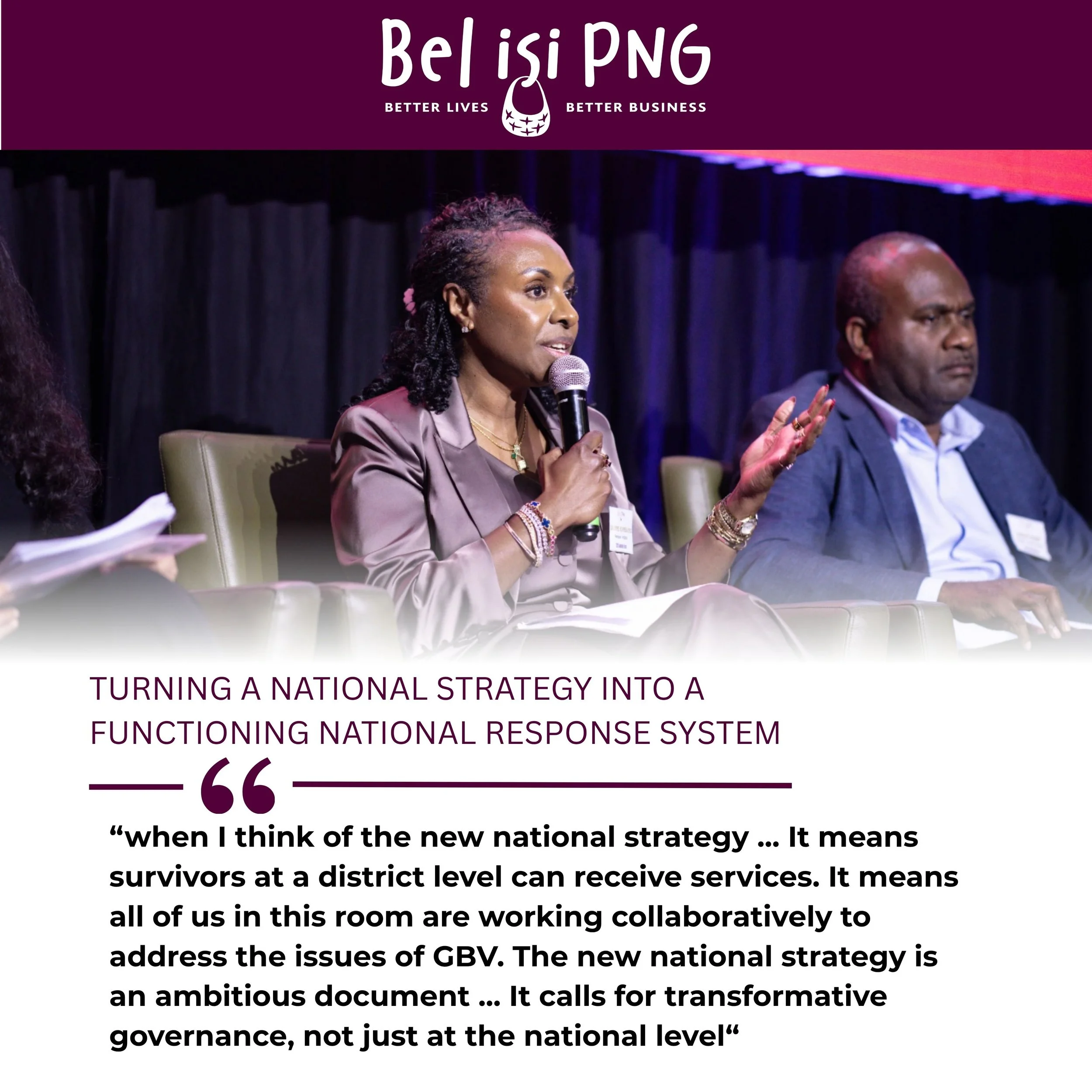
Speaking at the Bel isi PNG 7th Annual Leadership Forum, Ms. Kambanei described implementation as the next frontier in Papua New Guinea's response to GBV. Reflecting on the recently launched National GBV Strategy 2026 - 2035, she challenged stakeholders to move beyond viewing the strategy as a document and instead see it as a roadmap for coordinated action across government, communities, civil society, development partners, and the private sector.
Survivor-Centered Approach
For Ms. Kambanei, success is not measured by the number of policies produced but by whether survivors at the district and provincial levels can access the support they need. That includes safe houses, family support centers, legal assistance, health services, referral pathways, and trained frontline responders. It means ensuring that survivors do not have to travel hundreds of kilometers or navigate fragmented systems to seek help.
The National GBV Strategy is ambitious, calling for significant investment and multi-sector cooperation over the coming decade. However, Ms. Kambanei stressed that implementation must be grounded in provincial realities. Across the country, provincial capacities remain uneven. While some provinces have dedicated teams and established structures, others rely on a single officer responsible for multiple social welfare portfolios. Creating adequately staffed provincial GBV secretariats, strengthening local planning, and securing long-term funding are therefore central to turning national commitments into measurable outcomes.
Partnership and Shared Ownership.
Drawing on consultations conducted across Papua New Guinea, Ms. Kambanei noted that many communities trust local institutions such as churches, health workers, and provincial leadership structures. The Secretariat has responded by working directly with provincial governments to align local work plans with national priorities, ensuring that implementation is supported not only by policy direction but also by practical planning and budget allocations.
Addressing GBV Cannot Be the Responsibility Of One Agency Alone
Government departments, provincial administrations, churches, businesses, civil society organizations, frontline service providers, and community leaders all have a role to play. Lasting change depends upon coordinated action that connects prevention, protection, justice, and support services into a unified response.
Ms. Kambanei also highlighted the urgent need to address service gaps that continue to leave survivors vulnerable. Despite progress made over recent years, many provinces still lack safe houses and critical support infrastructure. Access to justice remains challenging, conviction rates remain low, and survivors often struggle to navigate complex systems. These realities, she argued, demonstrate why implementation matters as much as policy development.
Equally Important Is Prevention.
While responding to violence remains essential, Ms. Kambanei called for greater investment in behavioral change, youth engagement, and community-based prevention efforts. She warned that without addressing the underlying attitudes and social norms that drive violence, the country risks seeing continued increases in reported cases. Prevention, she said, must become a central pillar of the national response, alongside survivor services and justice reform.
Throughout the discussion, Ms. Kambanei demonstrated a leadership approach grounded in collaboration, accountability, and long-term change. Rather than viewing the National GBV Strategy as an end in itself, she sees it as a mechanism for mobilizing action and building stronger systems throughout Papua New Guinea.
Her contribution to the forum reinforced a powerful message: moving beyond the ink means ensuring that every policy commitment is backed by funding, people, partnerships, and practical services. It means creating a future where survivors can access support regardless of where they live and where institutions work together to prevent violence before it occurs.
As Papua New Guinea advances its national response to GBV and FSV, Diane Kambanei's work serves as a reminder that meaningful change is not measured by the policies we write, but by the lives we improve through their implementation.